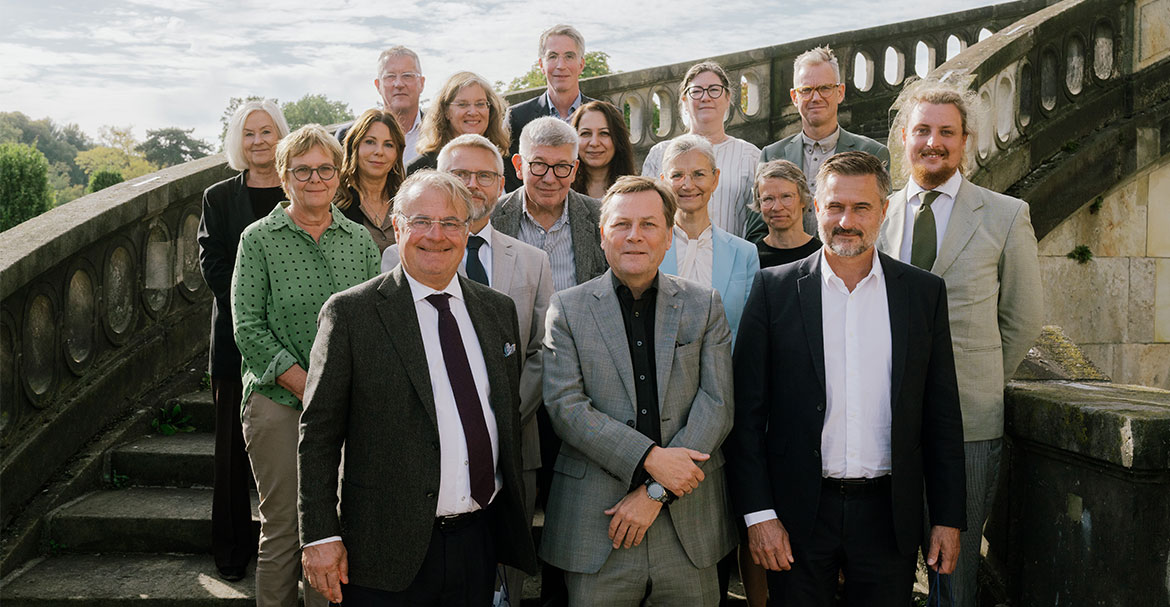
In talks with the University of Potsdam’s leadership, the Danish delegation was particularly interested in examples of good practice in supporting early-career researchers as well as the university’s structures and activities in the area of knowledge and technology transfer, which is also a key priority for SDU. The two universities therefore agreed to continue their discussions on these issues.
The visit also provided an opportunity to discuss similarities and differences between the higher education systems in Germany and Denmark. The two universities are similar in size, enrolling around 20,000 students each, and both place a strong emphasis on supporting start-ups and research-based spin-offs. Both also have particular strengths in computer science: SDU recently opened a new IT campus, while computer science is also a major area of research at the University of Potsdam.
There are, however, significant differences in the higher education systems and research landscapes of the two countries. Unlike Germany, Denmark does not have non-university research institutions comparable to the Max Planck, Leibniz, Helmholtz, or Fraunhofer organizations. As a result, there are also no joint professorial appointments comparable to those found in the German system. Other differences include the academic training of elementary school teachers and the structure of the higher education system, which does not have a type of institution comparable to Germany’s universities of applied sciences.
Another major topic of discussion was university funding and the strategic development of research priorities. Both universities face similar challenges in funding research and teaching. The Danish delegation was particularly interested in the balance between core funding and external funding, the role of the State of Brandenburg in setting research priorities, and the processes by which the University of Potsdam selects and funds its key research areas and emerging fields.
The two universities found common ground on the role universities play in society. The leadership of both institutions emphasized that universities must create value for society and clearly demonstrate that value – particularly at a time when research and academic institutions are facing increasing public criticism.
When it comes to internationalization, the two countries are taking different paths. In Germany, expanding English-taught degree programs and attracting international students are important priorities, not least in response to the shortage of skilled professionals. Danish universities, by contrast, are currently seeing a policy-driven shift in the opposite direction.
The conversations also covered international partnerships. SDU’s approach is built on three pillars: multilateral networks and European alliances, bilateral university-wide strategic partnerships, and strategic partnerships focused on specific research profiles.
The two universities already share one important connection: Both SDU and the University of Potsdam are members of YERUN, the Young European Research Universities Network. The visit highlighted not only overlaps in their research interests but also the challenges currently facing young research universities across Europe. Both universities therefore see potential for closer cooperation and plan to continue building their relationship.
Further information about YERUN is available here:
https://www.uni-potsdam.de/en/international/young-european-research-universities-network-yerun