Why did you participate in the DigiEduHack organized by YERUN?
Kai Speidel: I saw a post about it on LinkedIn from the University of Potsdam. I have participated in hackathons several times and find that you learn a lot – often more than in several weeks at university. It is also particularly exciting that such events often give you access to technologies that you would not otherwise be able to use. I was particularly interested in the topic: AI and education. I thought it was great and important to explore applications of AI that are not immediately obvious.
How exactly did the hackathon work?
Lucia Welther: At the beginning, a lot of communication took place via email, including initial information and the assignment of participants to groups. After that, we communicated as a team via the Discord platform. On the first two days, right before the actual hackathon, there were online workshops on artificial intelligence (AI), its possibilities and associated risks, and the expectations of the participants.
Speidel: After the kick-off days, the teams got together and looked for their topic. As long as it fell within the scope of “AI and education,” we were free to choose.
Welther: At our first meeting, we gathered ideas, always keeping the organizers' guidelines in mind: The focus should not be on AI, but on people. It should enrich life and not replace anything.
Speidel: Our focus quickly became clear: support for people with disabilities. There were four of us, and we were able to divide the tasks so that everyone could work on a specific type of disability with which we already had previous experience or personal connections.
What did your contribution consist of?
Welther: We developed a website that makes it easier for people with disabilities to access texts. Specifically, for those with ADHD, dyslexia, and autism, as well as for the deaf. Here's how it works: On the website, you can select one of four input fields and paste the text there. Depending on the individual difficulties someone has when dealing with texts, these are then restructured and supplemented accordingly – made understandable. The content remains unchanged, but becomes more accessible to users in the four different variants.
Speidel: We did extensive research on the four impairments in advance in order to make our approach evidence-based. For people with dyslexia, which I have been working on, for example, the text is converted into a special font that makes it easier to read. This font has larger spacing and presents the text in a simplified view. In addition, questions are generated after the text to help users better understand what they have read.
Welther: I have been working on ADHD, as I have previously collaborated on a project with children affected by this condition. In this section of the website, an overview is created for users to help them better prepare for the text, with brief information on questions such as: “What can I expect?” and “How long will it take to read?” In addition, the text is divided into sections and provided with subheadings to better structure it.
Speidel: Spike Cullen from Essex developed the section for people with autism. They often have difficulty understanding the emotional nuances of texts, whether something has positive or negative connotations. We therefore developed an approach that explicitly explains whether a section of text is meant to be positive or negative in order to improve understanding.
Welther: And Tùng Đỗ Duy from Vietnam delved into the difficult field of deafness. For affected people, our website contains animated stick figures that “read” the text in sign language.
How did you come up with your idea?
Welther: We started from the jury's premise: the task was to help and connect people, rather than just create a technically perfect programmed tool. We discussed several scenarios and quickly came up with the idea of a teaching scenario, particularly in a school context. The great thing was that everyone could contribute their own ideas and experiences.
How did you find each other as a team?
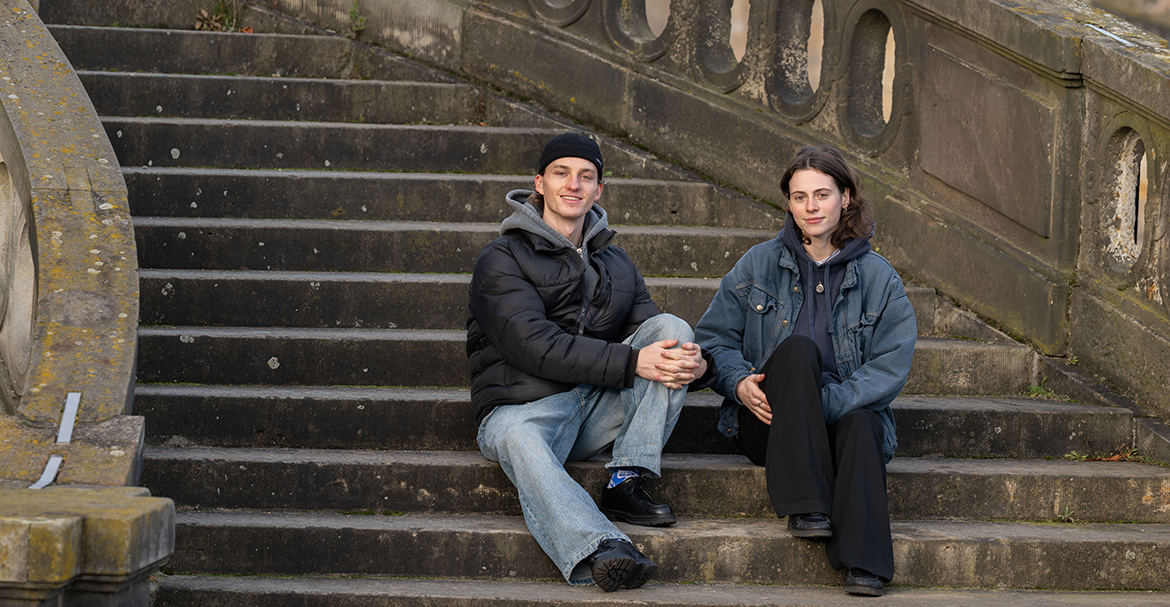
Speidel: Our team consisted of Tùng Đỗ from Duy Tan University in Vietnam, Spike Cullen from the University of Essex, and the two of us. Most of the hackathon participants came from Tor Vergata University in Rome, for whom the hackathon was probably a compulsory event. The remaining volunteers from various universities were then assigned to the other teams by lottery. For us, it was a good draw.
How did the collaboration with the others go?
Speidel: It was a bit chaotic at first, but once we got organized via Discord, things went much better. Two people from our original six-person team dropped out, but everyone who stayed was highly motivated and enthusiastic about the topic.
Welther: We had a three-hour online meeting every day. We developed our idea on the very first day and then concentrated on our respective tasks. The advantage of the online event was that there were many international participants. The four of us got along really well – and it would be great if we could meet in person again sometime.
And then you won...
Speidel: There were about 100 participants in the workshops at the beginning, but that number quickly dwindled. In the end, there were 30 left, which formed just under ten project teams. In a final event, all teams presented their ideas and developments to the jury. Each team had seven minutes to do so, followed by time for questions and discussion. The jury was very demanding and set high standards for the participants.
Welther: We were the first team to present. The jury really expected a lot and wanted to see how the ideas could be implemented. That worked in our favor because we had built a prototype and could show that our idea was really tangible – unlike other teams that hadn't reached that stage yet.
Speidel: In fact, there was at least one other team with a really good idea, which the jury explicitly acknowledged. But we were able to convince them with our prototype and had made the most progress overall.
What's next for your idea?
Speidel: The jury gave us constructive feedback and valuable input that showed us what we can improve further. And it really is moving forward, because by winning the hackathon, we've made it to the next round.
Welther: We didn't actually know that, because it hadn't been communicated to us. Maybe that's not such a bad thing for us. To be honest, we didn't think about it beforehand – neither about winning nor what comes next. We just got involved in the hackathon. We are all the more delighted that we can now develop our idea further.
Further information on DigiEduHAck: https://digieduhack.com
About the winning team “Team Alpha” led by Lucia Welther and Kai Speidel and their idea “Adaptly” - and for voting in the second round: https://digieduhack.com/solutions/adaptly