News from the University of Potsdam

Subjects
Selected Subject:
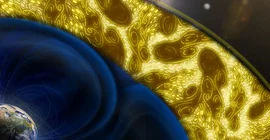
Künstlerische Darstellung der Turbulenzwirbel in der Magnetosphäre der Erde von großen zu kleinen Skalen. Eine zunehmende Helligkeit zeigt eine steigende Nichtlinearität an.

Toward unification of turbulence framework – weak-to-strong transition discovered in turbulence

Media Information 12-04-2024 / Nr. 023

Astrophysicists from the University of Potsdam have made a significant step toward solving the last puzzle in magnetohydrodynamic turbulence theory by …
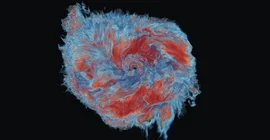
Numerical simulation of the resulting ejecta material of two merging neutron stars. Red colors refer to ejected material with a high fraction of neutrons which will appear typically redder than blue material that contains a higher fraction of protons.

Studying neutron stars on many channels in parallel

An international team of researchers, including the University of Potsdam and the Max Planck Institute for Gravitational Physics, has developed a …
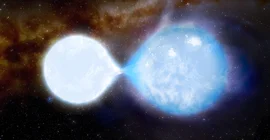
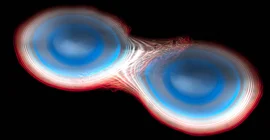
Binary star on course for black hole merger. The smaller, brighter, hotter star (left), which is 32 times the mass of our Sun, is currently losing mass to its bigger companion (right), which has 55 times the mass of our Sun.

Dark couple – Most massive touching stars ever found will eventually collide as black holes

Two massive touching stars in a neighbouring galaxy are on course to become black holes that will eventually crash together, generating waves in the …
Prof. Dr. Tim Dietrich

Astrophysicist Prof. Dr. Tim Dietrich receives IUPAP Early Career Scientist Prize

A good start in 2023: Astrophysicist Prof. Dr. Tim Dietrich receives IUPAP Early Career Scientist Prize in General Relativity and Gravitation and a …
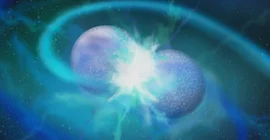
Simulation of two merging neutron stars, each with a mass of 1.35 solar masses. From red to blue, increasing densities are shown.

Tim Dietrich receives ERC Starting Grant for exploring binary neutron stars

Tim Dietrich, seit 2020 Professor für Theoretische Astrophysik an der Universität Potsdam und Max-Planck-Fellow am Max-Planck-Institut für …
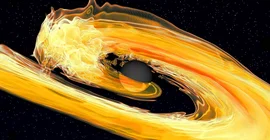
Simulation of a neutron-star/black-hole coalescence in which the neutron star is tidally disrupted during the merging process.

Einstein Put To the Test – Gravitational Wave Researcher Prof. Tim Dietrich Is Dealing With Heavy Weights In Space

Tim Dietrich is only 34 years young and has already had a remarkable scientific career: In 2017, PhD thesis with distinction at Friedrich Schiller …
Numerical-relativity simulation of the binary neutron star coalescence and merger which resulted in the detected gravitational wave event GW190425.

Hypermodels help understand gravitational waves

A new approach to analyze binary neutron star mergers, developed by Dr. Gregory Ashton (University of London) and Prof. Dr. Tim Dietrich (Potsdam …
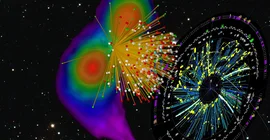
Künstlerische Darstellung einer numerisch-relativistischen Simulation der Verschmelzung zweier Neutronensterne mit einem Bild der bei einer Goldionen-Kollision entstandenen Teilchen.

New insights into neutron stars matter

For the first time, an international research team, including Prof. Dr. Tim Dietrich (Potsdam University/Max Planck Institute for Gravitational …
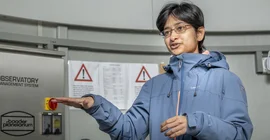
Humboldt Fellow Dr. Anuradha Samajdar

Fascinating Universe – Humboldt Fellow Anuradha Samajdar on Analysis of Gravitational Waves

Since January 2022 Dr. Anuradha Samajdar has been a Humboldt Fellow in the Theoretical Astrophysics research group at the Institute of Physics and …
Artistic View of a white dwarf merger.

Rare Stellar Wedding – Astronomers find stars covered in helium burning ashes

Astronomers of the Universities of Potsdam and Tübingen discovered puzzling star surfaces covered with carbon and oxygen which might have formed in a …