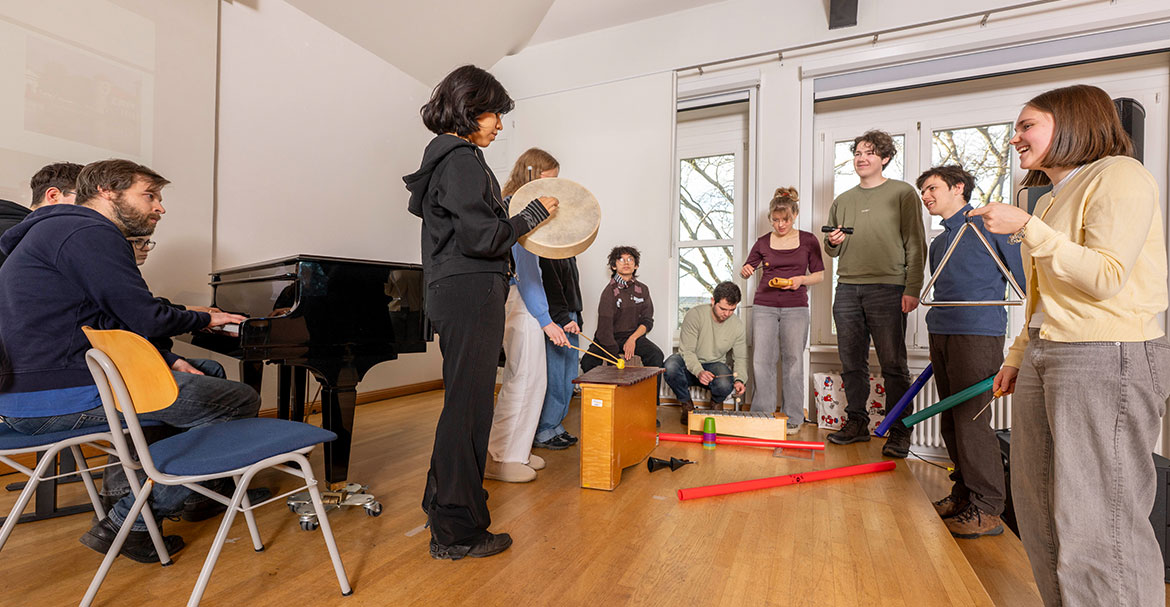
At first, all the instruments sound independently, but within just two minutes the students begin to synchronize with one another so that – though somewhat unevenly, yet clearly perceptible – music begins to emerge.
After a brief discussion, a second attempt begins. Dynamics come into play, structure becomes recognizable, a sense of collaboration develops. The students reflect on what they have done: It all begins with listening to one another, then reacting, and finally contributing something of one’s own.
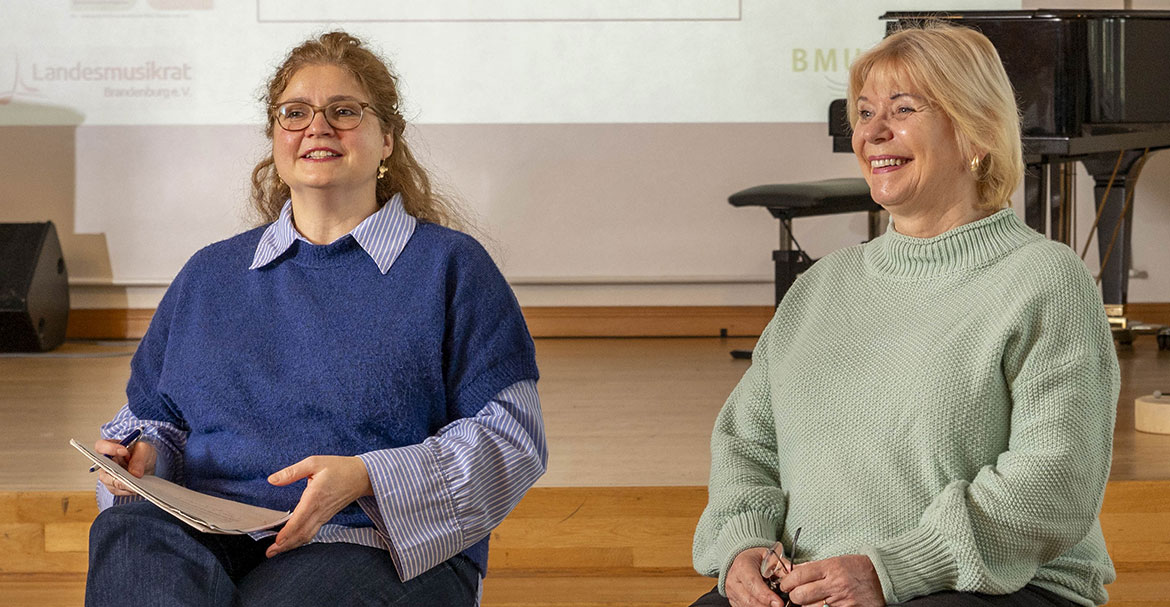
“From the very beginning, they followed democratic principles. They considered how to work with the musical parameters and, regardless of the guidelines, ultimately achieved much more than was asked of them.” The person saying this is an expert in two respects: musicologist and State Parliament President Prof. Dr. Ulrike Liedtke, who teaches at the University of Potsdam and was invited to the seminar by Jana Buschmann. For her, what matters most is the tension that is created, the contrasts between sounds and elements from which something new can develop.
While the students primarily associate tension with the lengthy discussions they have in their own bands before reaching a musical consensus, Liedtke has music itself in mind. She explains what she means using the example of sonata form: Just as in parliament, a theme is introduced at the beginning, in the “exposition,” followed by a second as a counterpoint, and sometimes a third or fourth as an aside. In the “development,” the debate unfolds: statement and counterstatement. Finally, the “recapitulation” serves as a reminder, a return to the starting point, before the finale determines which side gains the upper hand.
Other musical forms, such as variations, also lend themselves to comparison with democracy. They show how differently people can approach a theme: wildly and energetically, slowly and dreamily, or playfully and ornamentally. “Diversity and democracy are mutually dependent,” Prof. Liedtke says, drawing the students’ attention to the political dimensions of music: “When we sing the ‘Ode to Joy,’ we emphasize what unites us: ‘Every man becomes a brother.’” As president, she once organized a concert featuring Arab and Israeli musicians in the state parliament.
“There are so many wonderful ways to make music,” says Buschmann, encouraging her students to make the cultural diversity of their pupils a focus of classroom teaching. “Give students space to help shape the content and structure of music lessons so that they perceive what they’re doing as meaningful and are committed to it.” Protest songs from around the world are well suited to approaching democracy in music on a thematic level, the lecturer knows. This also includes examining the misuse of musical works in dictatorships. “Why does this music have such an effect? How can I use my intellect to counter it when I recognize the manipulation?” A difficult topic that requires a great deal of sensitivity and a trusting learning environment. Buschmann sees the teaching of essential skills as a prerequisite here. “In addition to knowledge about politics, you need knowledge about music and how it’s made.” Equally important, she adds, are critical self-reflection and the ability to analyze complex issues and speak about them, “in order to take a stand and defend our democratic values.”
Is this too much to ask of music education? “We only have one hour per week,” student Roland Lutz points out. “And does the curriculum provide enough freedom for that?”
Liedtke and Buschmann, who have been advocating for their subject for many years in the State Music Council and at the national level in the German Music Council, see clear connections to political education and history. Music can also play a role in art, sports, and literature. Even in physics class, for example, when it comes to vibrations or electroacoustics. The framework curriculum for music also offers sufficient freedom, Buschmann says, pointing to the competency area “Reflecting on and contextualizing music” and the thematic areas “The impact and function of music” as well as “Music in a cultural context.”
Nevertheless, there seems to be a barrier to genuine participation that may lie within the subject itself. “Many children don’t have the opportunity to learn an instrument,” Rasmus Gurr adds. Notions of elitism often come into play here as well, the student notes. And the opportunity to sing in a choir or play in an orchestra is frequently taken up only by those who already attend music school. “That’s exactly why it’s so important to instill a love of making music in everyone in the class and to take away the fear of failure,” Buschmann explains.
Prof. Liedtke regards music as a form of communication – among performers and with listeners. This communication works through speech, singing, or playing an instrument when everyone listens to one another, interacts and responds, pauses, and finds the right moment to join in. Just like in a good political debate. This doesn’t require perfection on a musical instrument; one’s own instrument – the voice – is enough. “And when the working group is called ‘Maulwerken’ instead of ‘Choir,’ the barrier isn’t quite as high anymore,” notes the professor, who also enjoys proposing sound experiments in which everyone can participate and learn something. Sometimes all it takes is newsprint paper, which can be rustled, tapped, and crackled rhythmically while political headlines are shouted into the room …
This article appeared in the university magazine Portal - Eins 2026 „Inklusion“.